

Tip #1: Sometimes, You Should C-Bet with Your Entire Range in Position
There are paired textures that require a very aggressive c-betting strategy. Take a moment to consider which types of paired textures are more favorable to the preflop aggressor in position.
These are textures paired by Broadway cards, for example:
- A♠ A♥ 8♦
- K♣ K♦ 7♥
- Q♦ Q♣ 2♦
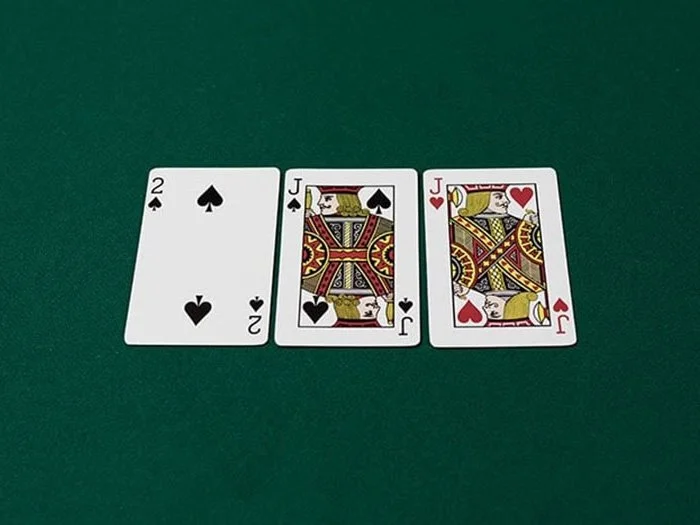
- J♠ J♦ 4♥
- T♥ T♠ 5♣
As the preflop aggressor in position, it’s a good idea to c-bet with 100% of your range on such textures because your range benefits from a wider variety of strong Broadway connections (e.g., AK, AQ, KQ, etc.) compared to the out-of-position caller. Ultimately, the player out of position must 3-bet these hands quite often.
Tip #2: Sometimes, You Should NOT C-Bet with Your Entire Range in Position
While the player in position maintains a substantial range advantage on such flops, the nut advantage lies with the preflop caller. The discrepancy between the nut distribution (the strongest hands in the range) becomes more evident as the rank of the paired cards decreases.
In this scenario, the player who defended out of position can begin aggressively check-raising. By doing so, they force the player in position to check behind with many hands that cannot call a check-raise, opting to simply check back and realize their equity.
Hands most affected by betting and getting raised (thus, more interested in checking) are middle Ax and the strongest Kx hands (like KQ and KJ). These hands have a limited showdown value, deny a large amount of equity by betting, and do not get much value when betting. Hence, you should often check behind with them.
Tip #3: Aggressively Check-Raise as the Defender
As mentioned in the previous tip, you need to defend aggressively on paired boards when facing aggression from the preflop raiser. Simply calling is not enough. The player in position can realize too much of their equity at the expense of your range.
The lower the rank of the paired card, the more you want to check-raise because your nut advantage will be higher. Your range for check-raising should be linear, not polarized. A linear range consists of medium-strength hands, so any hand you consider good enough for a call should sometimes also be raised.
Tip #4: Aggressively C-Bet Out of Position When a Broadway Card Pairs
In general, against a tight calling range, you should implement a highly defensive strategy out of position. However, when a paired board is created by a Broadway card, you should use a very aggressive c-betting strategy. C-betting with your entire range is often the correct approach in such situations.
This is the optimal strategy because you will have a significant nut advantage. This is due to the fact that the preflop caller’s range typically lacks hands like AK, AQ, KQ because they did not 3-bet them preflop.
Tip #5: Typically, Check with Your Entire Range When Out of Position in Multiway Pots
Multiway pots are very complex. There is no universally agreed upon approach to playing them because, until recently, it was impossible to study them using solvers.
Considering that approximately 17% of all flops are paired, it is crucial to play them skillfully. Remember that it’s easier to play paired flops for the in-position player and more challenging for the out-of-position player. Make sure to apply significant pressure on such flops in position, whether you are the preflop aggressor or the caller.
Conclusion: When dealing with paired flops in Texas Hold’em, knowing how to adapt your strategy is crucial. It’s vital to recognize the advantages of position and leverage them to make profitable decisions. Whether you’re the aggressor or the caller, these tips will help you navigate paired flops effectively.